WHATSAPP LEAD MANAGEMENT
CAPTURE · QUALIFY · FOLLOW UP
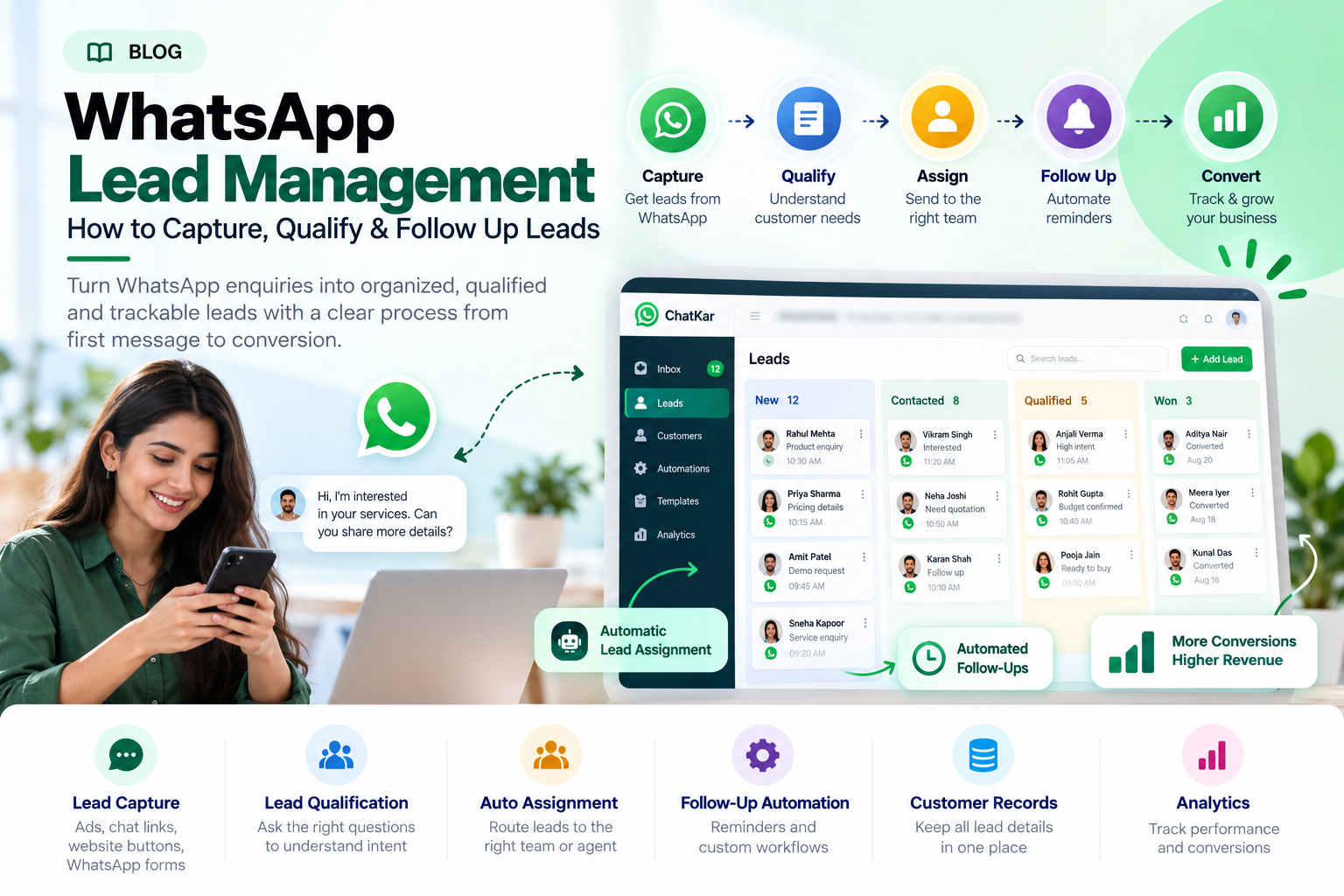
WhatsApp Lead Management: How to Capture, Qualify & Follow Up Leads
WhatsApp can generate a large number of customer enquiries, but receiving
leads is only the first step. Businesses need a repeatable way to capture,
qualify, assign, follow up and track those leads.
WhatsApp lead management connects incoming conversations
with customer records, sales teams, qualification questions, follow-up
workflows and reporting.
This guide explains how WhatsApp lead management works, the most useful
lead-capture methods, qualification, routing, automation, follow-up,
tracking and the mistakes businesses should avoid.
Quick Answer: What Is WhatsApp Lead Management?
WhatsApp lead management is the process of
capturing, organizing, qualifying, assigning, following up and tracking
leads that come through WhatsApp.
The goal is simple: make sure a useful enquiry does not get lost inside
a chat history.
Capture
Bring the enquiry into the sales workflow.
Qualify
Understand the customer's need and intent.
Assign
Send the lead to the right person.
Follow Up
Keep the next action visible.
Track
Measure what happens after the enquiry.
Why WhatsApp Leads Get Lost
Most businesses do not lose leads because WhatsApp cannot receive them.
They lose leads because the process after the first message is inconsistent.
📥
Leads Stay Inside Chats
Nobody creates a clear record of the enquiry.
👥
No Ownership
Several employees see the lead but nobody clearly owns it.
⏰
Follow-Up Is Forgotten
The first response happens but the second or third contact never happens.
📊
No Visibility
Managers cannot easily tell how many leads are open or qualified.
The WhatsApp Lead Management Journey
A simple lead journey can look like this:
Enquiry
New lead
→
Capture
Create record
→
Qualify
Understand need
→
Assign
Owner
→
Follow Up
Next action
→
Outcome
Won / Lost / Later
7 Ways to Capture Leads on WhatsApp
01
Click-to-WhatsApp Ads
Customers can move directly from an advertisement into a WhatsApp conversation.
This removes friction between discovering a business and starting an enquiry.
02
Website WhatsApp Buttons
Add WhatsApp entry points to product pages, landing pages and contact pages.
03
WhatsApp Chat Links
Share trackable WhatsApp links across social media, email, brochures,
QR codes and other campaigns.
04
WhatsApp Forms
Ask qualification questions inside a structured WhatsApp experience rather
than relying only on free-form chat.
05
QR Codes
Offline campaigns, packaging, events, stores and printed materials can
direct prospects into WhatsApp.
06
Social Media CTAs
Instagram, Facebook and other channels can use WhatsApp as the next step
from content or campaigns.
07
Existing Customer Referrals
Existing customers can start conversations on behalf of new prospects
through a shared or trackable entry point.
ChatKar currently lists Meta Click-to-WhatsApp ads, WhatsApp Forms and
trackable WhatsApp chat links among its features. :chatgpt-content-reference{index="1"}
How to Qualify WhatsApp Leads
Lead qualification should collect only information that helps the business
decide what happens next.
Requirement
What product or service does the person need?
Budget
Is budget relevant to this purchase?
Timeline
Does the customer need something now or later?
Location
Is geography important to the product or service?
Use Case
Why is the customer looking for the solution?
Priority
Does the enquiry need immediate attention?
Example:
"Which service are you interested in?" →
"When are you planning to start?" →
"Which city are you located in?" →
"Our relevant team member will contact you."
Assign Each WhatsApp Lead to the Right Person
After qualification, the lead should have a clear owner.
Assignment can be manual or automated depending on the system.
Round Robin
Distribute new leads across available agents.
Department
Route enquiries to sales, support or another queue.
Location
Route by city, state, region or market.
Product
Send specialized leads to product specialists.
ChatKar currently lists auto-assignment routing rules as part of its WhatsApp
workflow capabilities. :chatgpt-content-reference{index="2"}
WhatsApp Lead Follow-Up: What Should Happen Next?
One of the biggest advantages of a lead-management system is that the next
action does not have to depend entirely on someone's memory.
Example Lead Follow-Up Timeline
First Contact:
Answer the enquiry and identify the requirement.
Follow-Up 1:
Contact the lead if no response arrives.
Follow-Up 2:
Share a relevant answer, document, product detail or update.
Later Follow-Up:
Move the lead into an appropriate future follow-up state if needed.
For business-initiated WhatsApp messages outside the applicable customer-service
window, businesses need approved message templates under the current WhatsApp
Business policy. WhatsApp also requires clear escalation options when automation
is used during the 24-hour window. :chatgpt-content-reference{index="3"}
What Parts of WhatsApp Lead Management Should Be Automated?
Good Candidates for Automation
- Welcome messages
- Basic qualification questions
- Lead routing
- Reminders
- Status updates
- Common FAQs
- Lead tagging
Better for Human Agents
- Price negotiation
- Complex requirements
- High-value leads
- Objections
- Custom quotations
- Escalations
- Closing conversations
The right balance is usually not maximum automation. It is automation of
repetitive work plus fast access to a human when the conversation needs judgment.
Create Clear WhatsApp Lead Statuses
Lead statuses make it easier for a team to understand what is happening
without reading every conversation.
New
Contacted
Qualified
Proposal
Follow-Up
Won
Lost
Later
WhatsApp Lead Management Metrics
Lead management becomes much more useful when managers can measure what
happens after the first message.
Lead Volume
How many enquiries are arriving?
Response Time
How quickly does someone respond?
Qualification Rate
What portion of enquiries become qualified leads?
Follow-Up Rate
How many qualified leads receive follow-up?
Conversion Rate
How many managed leads become customers?
Lead Source
Which campaigns generate useful enquiries?
CHATKAR
Manage WhatsApp Leads With ChatKar
ChatKar currently brings lead capture, customer conversations, team inboxes,
auto-assignment, flow automation, WhatsApp Forms, Click-to-WhatsApp,
chat links and analytics into the same platform. :chatgpt-content-reference{index="4"}
Lead Capture
Capture enquiries from WhatsApp entry points.
Auto Assignment
Route leads to the correct agent or team.
Flows
Build structured customer journeys.
Forms & Links
Create additional WhatsApp lead-entry points.
Analytics
Track messaging and customer activity.
Campaign
→
WhatsApp
→
Lead Capture
→
Qualification
→
Assignment
→
Follow-Up
The benefit is keeping customer communication and lead operations inside
the same workspace instead of moving information manually between several tools.
WhatsApp Lead Management Best Practices
1. Respond Quickly
Define a realistic response process for new enquiries.
2. Ask Useful Questions
Qualify without turning the chat into a long form.
3. Give Every Lead an Owner
Make responsibility obvious.
4. Automate the Repetitive Parts
Let the system handle predictable steps.
5. Keep Human Handover Easy
High-value or complex leads should reach people quickly.
6. Measure Outcomes
Track lead quality and conversion, not just message volume.
Common WhatsApp Lead Management Mistakes
1. Capturing Leads but Not Assigning Them
A lead record without an owner can still get ignored.
2. Asking Too Many Qualification Questions
Long questionnaires can reduce the quality of the conversation.
3. No Follow-Up System
Qualified leads often need several interactions before making a decision.
4. Automating Everything
Some conversations require a human salesperson.
5. Measuring Only Lead Quantity
More leads do not automatically mean better sales results.
WhatsApp Lead Management and Customer Data
Lead management involves customer information, so businesses should think
about consent, privacy, access controls and how customer data is used.
Important:
WhatsApp's current Business Policy requires businesses to obtain appropriate
notices, permissions and consent for collecting, using and sharing customer
information, and it places restrictions on requesting or sharing certain
sensitive information. :chatgpt-content-reference{index="5"}
Frequently Asked Questions
What is WhatsApp lead management?
It is the process of capturing, organizing, qualifying, assigning,
following up and tracking leads that come through WhatsApp.
How can I capture leads from WhatsApp?
Common entry points include Click-to-WhatsApp ads, website buttons,
WhatsApp links, QR codes, forms and social media CTAs.
Can WhatsApp leads be automatically assigned?
Yes. Compatible platforms can use routing rules to assign leads based
on factors such as team, workload, location or product.
Can I automate WhatsApp lead follow-ups?
Yes. Compatible systems can automate supported reminders, journeys,
routing and other follow-up workflows.
Can WhatsApp Forms help with lead capture?
Yes. WhatsApp Forms can collect structured information inside a WhatsApp
experience. ChatKar currently lists WhatsApp Forms among its features. :chatgpt-content-reference{index="6"}
What is the difference between WhatsApp lead generation and lead management?
Lead generation is about acquiring enquiries. Lead management is what
happens after the enquiry arrives: capture, qualification, ownership,
follow-up and outcome tracking.
Should every WhatsApp lead be automated?
No. Automate repetitive tasks while keeping human handling available
for complex, high-value or sensitive conversations.
Can WhatsApp lead management connect with a CRM?
Yes. API-based platforms can connect WhatsApp lead workflows with CRM
and other business systems through supported integrations.
Does ChatKar support WhatsApp lead management?
ChatKar currently lists lead capture, auto-assignment routing, WhatsApp
Forms, Click-to-WhatsApp, chat links, flow automation and analytics among
its capabilities. :chatgpt-content-reference{index="7"}
Related WhatsApp CRM & Sales Guides
Final Thoughts
WhatsApp lead generation can bring customers to your business quickly,
but lead management determines what happens after the first message.
A strong process does not require every interaction to be automated.
It requires every lead to have a clear path:
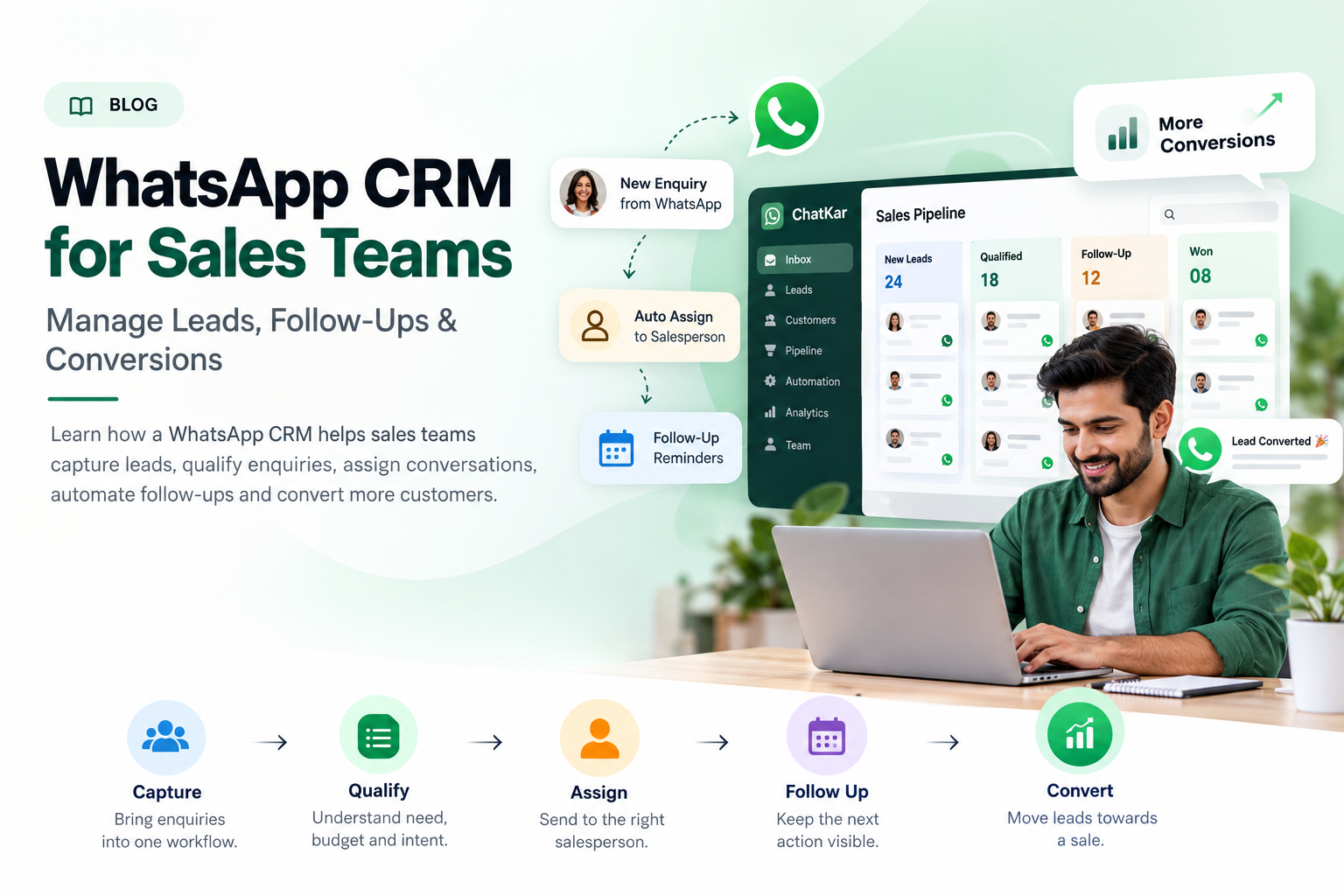
Capture → Qualify → Assign → Follow Up → Track → Convert
That is the foundation of a scalable WhatsApp lead-management workflow.
Once this process is structured, businesses can decide where automation,
AI, CRM integrations and human sales involvement should fit.
Turn WhatsApp Enquiries Into Managed Leads
Capture leads, qualify enquiries, assign conversations, automate follow-ups
and track customer journeys with ChatKar.
Explore Features
View Pricing