WhatsApp Business Platform helps businesses communicate with customers at scale through customer support,
notifications, authentication, marketing campaigns and automation.
With Meta's current pricing model, businesses are charged based on
delivered messages, the message category, and the
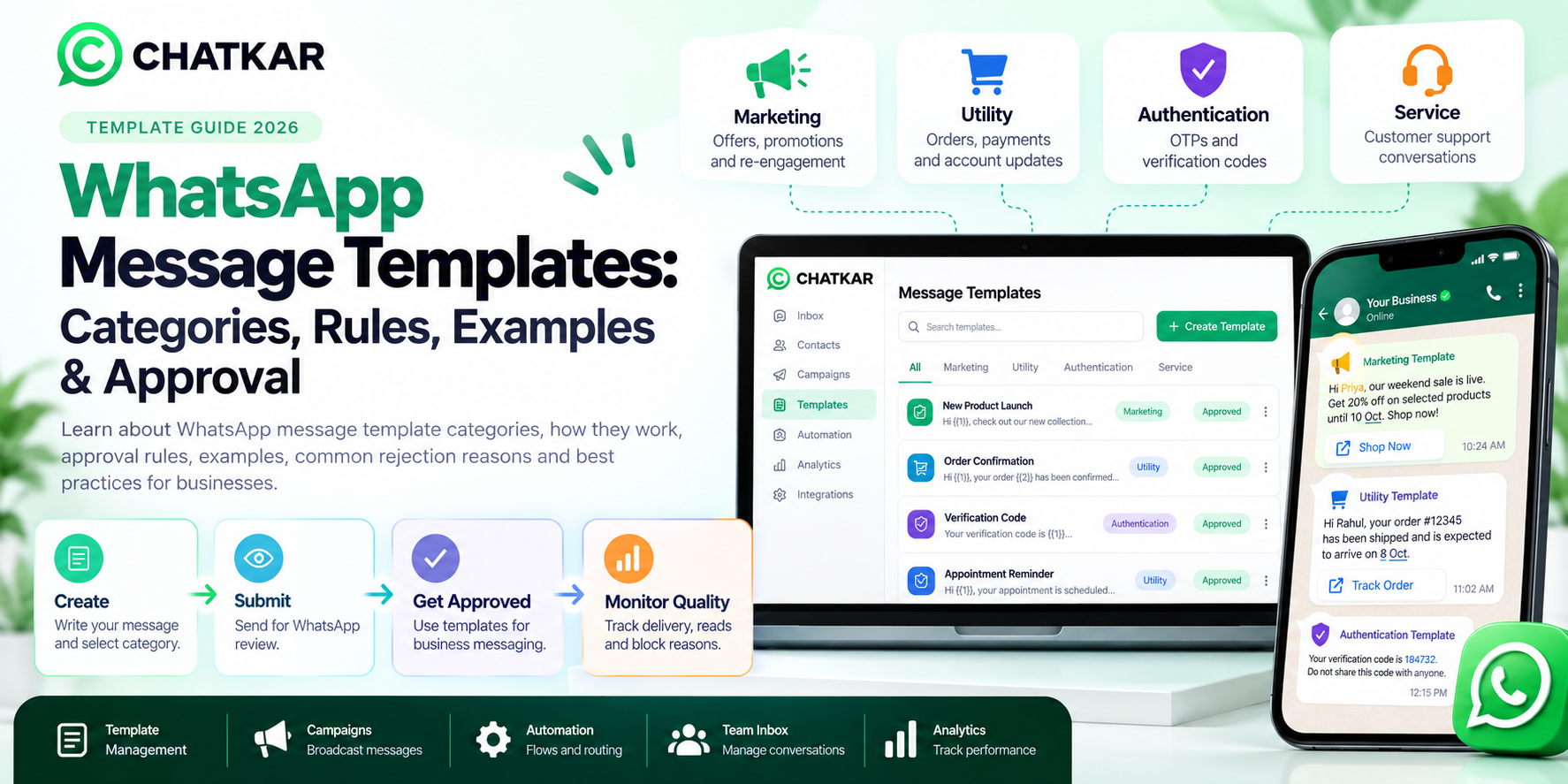
recipient market. Meta currently defines four message categories:
Marketing, Utility, Authentication and Service.
Understanding these categories is important for businesses using WhatsApp API, chatbots,
CRM automation, AI agents and customer support platforms such as ChatKar.
Official Meta WhatsApp Business Platform Pricing:
View Meta's official WhatsApp pricing page
1. How Does WhatsApp Business Platform Pricing Work?
Meta charges businesses based on messages that are delivered to users,
rather than simply messages that are sent.
The applicable price depends on:
- Recipient market
- Message category
- Applicable Meta pricing rules
- Volume tiers, where applicable
The four WhatsApp Business Platform message categories are:
- Marketing
- Utility
- Authentication
- Service
Meta publishes market-specific pricing through its official pricing page.
Official Meta Pricing:
https://whatsappbusiness.com/products/platform-pricing/
2. What Is a WhatsApp Service Message?
A Service Message is a response to a customer-initiated conversation.
Service messages are designed to help businesses manage incoming customer enquiries
through human agents, chatbots or conversational AI.
Examples include:
- Answering a customer's enquiry
- Providing product information
- Helping with an order
- Answering support questions
- Checking account information
- Providing booking or service assistance
- Responding through an AI chatbot
When a customer sends a message to a business, a
24-hour customer service window opens.
During this window, businesses can respond with Service Messages
without a Meta messaging charge.
The window resets whenever the user sends another message.
3. Are WhatsApp Service Messages Charged?
No.
According to Meta's current official pricing page, Service Messages are not charged
when responding to customers within the applicable 24-hour customer service window.
This is particularly important for businesses using:
- WhatsApp Chatbots
- AI customer support
- CRM automation
- Shared inboxes
- Human-agent support
- Customer enquiry flows
Example:
Customer:
"Can you tell me the price of this product?"
Business:
"The price is ₹2,999. Would you like to place an order?"
This type of customer-service interaction falls under the Service Message category
when it meets Meta's applicable rules.
4. What Is the 24-Hour Customer Service Window?
The 24-hour customer service window begins when a user sends a message to the business.
During this window, businesses can generally respond using free-form Service Messages
without requiring an approved template.
The window resets each time the customer sends a new message.
Example:
A customer sends a WhatsApp message at:
10:00 AM
The business can respond with Service Messages during the applicable 24-hour window.
If the customer sends another message at:
8:00 PM
the customer service window resets based on that new user message.
Outside the 24-hour customer service window, businesses generally need to use
an approved Message Template to initiate or continue messaging.
5. What Are Utility Messages?
Utility Messages are generally related to a user's transaction,
request or an action they have taken.
Examples include:
- Order confirmation
- Payment confirmation
- Shipping updates
- Delivery notifications
- Appointment reminders
- Account updates
- Transaction-related notifications
Meta describes Utility Messages as messages that are generally triggered by a user action
and are non-promotional.
Are Utility Messages Free?
Meta's current pricing page states that businesses are
not charged for Utility Messages sent in response to users.
However, Utility Messages are a separate category from Service Messages.
Businesses should therefore classify templates correctly according to Meta's
message-category guidelines.
6. What Are Authentication Messages?
Authentication Messages are used for identity verification and one-time passwords (OTPs).
Common examples include:
- Login OTP
- Registration OTP
- Account verification
- Transaction verification
- Identity verification
Meta identifies Authentication as one of the four WhatsApp Business Platform
message categories.
Unlike Service Messages, Authentication Messages are subject to Meta's applicable pricing.
Meta also provides volume tiers for Utility and Authentication messages,
allowing businesses to access different pricing as message volumes increase.
7. What Are Marketing Messages?
Marketing Messages are designed for promotional and business-growth activities.
Examples include:
- Offers
- Discounts
- Product promotions
- New product announcements
- Retargeting campaigns
- Promotional campaigns
- Related product recommendations
- Abandoned-cart campaigns
Meta describes Marketing Messages as messages that can be used across the customer journey
to generate awareness, drive sales and retarget customers.
Marketing Messages are chargeable according to the applicable Meta market
and pricing category.
Therefore, businesses running WhatsApp marketing campaigns should carefully monitor
campaign volumes and the applicable country-specific rates.
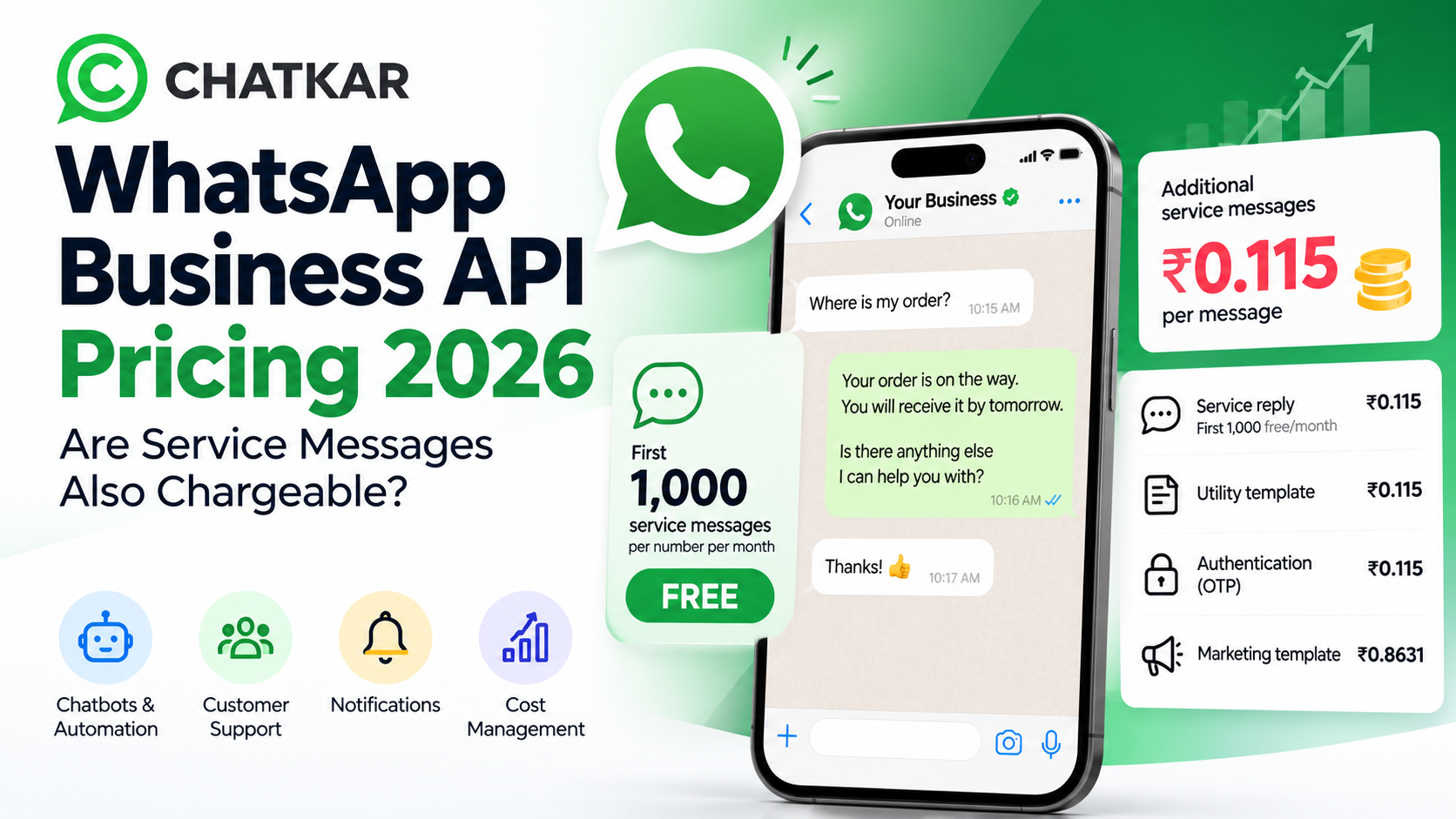
8. WhatsApp Message Pricing Categories at a Glance
| Message Category |
Typical Purpose |
Meta Pricing |
| Service |
Customer support and responses to incoming enquiries |
No charge during applicable 24-hour customer service window |
| Utility |
Transactional and user-requested updates |
No charge for Utility Messages sent in response to users; other applicable rules may apply |
| Authentication |
OTP and identity verification |
Charged according to applicable Meta rates and volume tiers |
| Marketing |
Promotions, offers and campaigns |
Charged according to applicable Meta rates |
Meta's pricing varies by market and message category, so businesses should always
check the current official rate card before calculating costs.
9. What Happens After the 24-Hour Customer Service Window?
Once the 24-hour customer service window has closed, businesses generally cannot
send free-form Service Messages.
If the business wants to send a new message outside the window, it generally needs
to use an approved Message Template.
The applicable template category may be:
- Marketing
- Utility
- Authentication
depending on the purpose and content of the message.
This is why correct template classification is important for WhatsApp API users.
10. Are Messages from Click-to-WhatsApp Ads Free?
Meta currently provides a free entry-point benefit for conversations that originate
from an Ad that clicks to WhatsApp or a Facebook Page
call-to-action button.
For the following 72 hours, all messages sent in that conversation
are not charged.
This can be particularly useful for businesses running:
- Facebook Ads
- Instagram Ads
- Click-to-WhatsApp campaigns
- Lead-generation campaigns
Example:
Customer clicks an advertisement → Opens WhatsApp → Starts a conversation.
The resulting 72-hour free-entry period can allow businesses to communicate with
that customer without Meta message charges during the applicable period.
11. Does This Affect WhatsApp Chatbots and AI Automation?
Yes, businesses using automation should understand the message categories and
the 24-hour customer service window.
Examples include:
- AI chatbots
- WhatsApp CRM
- Automated customer support
- Lead qualification bots
- Human-agent inboxes
- Order management
- Appointment systems
- AI sales assistants
When a customer initiates a conversation, businesses can use Service Messages
during the applicable 24-hour customer service window without a Meta messaging charge.
However, businesses should not assume that every automated message is
automatically a Service Message.
The purpose and context of the message determine the applicable category.
12. How Can Businesses Reduce WhatsApp API Costs?
1. Use Service Messages for Customer Support
When customers initiate conversations, handle their enquiries within the applicable
24-hour service window.
2. Classify Templates Correctly
Keep Marketing, Utility and Authentication templates properly separated.
3. Avoid Unnecessary Marketing Messages
Send promotional messages only to relevant audiences and according to WhatsApp's
applicable policies.
4. Monitor Message Volumes
Track message usage by category and recipient market.
5. Use Click-to-WhatsApp Campaigns Strategically
Where applicable, the 72-hour free-entry period can help businesses manage costs
for conversations originating from Click-to-WhatsApp Ads or Facebook Page CTA buttons.
6. Review Meta Billing Regularly
Compare your WhatsApp Manager billing information with your platform or provider reports.
13. Frequently Asked Questions
Are WhatsApp Service Messages Free?
Yes. Meta's current official pricing page states that Service Messages are not charged
when businesses respond to users during the applicable 24-hour customer service window.
Does the 24-hour window reset?
Yes. The 24-hour customer service window resets whenever the user sends another message.
Are Utility Messages Free?
Meta currently states that it does not charge for Utility Messages that businesses send
in response to users. Other Utility messaging scenarios remain subject
to applicable Meta pricing rules.
Are Marketing Messages Free?
No. Marketing Messages are subject to the applicable Meta pricing for the recipient market.
Are Authentication Messages Free?
Authentication Messages are subject to applicable Meta pricing.
Meta also provides volume tiers for Utility and Authentication Messages.
Are incoming customer messages charged?
Meta's pricing model is based on messages delivered by the business.
A customer message also opens or resets the applicable 24-hour customer service window.
Can I send a free-form message after 24 hours?
Generally, no. Outside the 24-hour customer service window, businesses generally
need to use an approved Message Template.
Are Click-to-WhatsApp conversations free?
Meta currently provides a 72-hour free-entry period for conversations
that originate from Click-to-WhatsApp Ads or Facebook Page call-to-action buttons.
During that period, all message categories are not charged.
Does ChatKar charge Meta's messaging fees?
Meta messaging charges and ChatKar's platform or service fees are separate.
If you use ChatKar for WhatsApp automation, your total cost can include your
ChatKar plan along with applicable Meta messaging charges.
14. Important Pricing Note for Businesses
WhatsApp pricing can change based on:
- Recipient market
- Message category
- Meta pricing updates
- Volume tiers
- Applicable messaging rules
- Business account configuration
Therefore, businesses should not rely on old WhatsApp pricing tables or third-party
articles when calculating current costs.
Always verify the latest pricing directly from Meta.
Official Meta Pricing
WhatsApp Business Platform – Official Pricing
Meta's official pricing page provides the current market and category-based pricing
information and allows businesses to review applicable rates and volume tiers.
Conclusion
WhatsApp Business Platform pricing is based on message delivery, message category
and recipient market.
The four main categories are:
Marketing • Utility • Authentication • Service
For customer support, the most important point is that
Service Messages are currently not charged during the applicable
24-hour customer service window. The window resets whenever the customer
sends another message.
Utility Messages also have specific pricing treatment, including no charge for
Utility Messages sent in response to users, while Marketing and Authentication
Messages follow their applicable pricing rules.
For businesses using WhatsApp API, CRM systems, chatbots or AI agents,
understanding these categories can help improve cost control and avoid incorrect
assumptions about WhatsApp pricing.
Before making purchasing, budgeting or billing decisions, always check the latest
official Meta pricing information.
Power Your WhatsApp Communication with ChatKar
Manage WhatsApp conversations, automation, CRM, chatbots and AI-powered customer
communication from one platform.
Explore ChatKar:
https://chatkar.com/
Whether you are managing customer enquiries, building automated WhatsApp flows,
using AI agents or connecting WhatsApp with your business processes, ChatKar helps
you manage customer communication from one place.
Disclaimer
Pricing and policy disclaimer:
This article is for general informational purposes only. WhatsApp Business Platform
pricing, message categories, eligibility requirements, volume tiers and messaging
policies may change.
The information in this article is based on Meta's official WhatsApp Business Platform
pricing information available at the time of publication. Meta may update pricing,
policies, eligibility requirements or billing rules without notice.
Always verify the latest applicable pricing and terms directly through Meta before
making purchasing, budgeting or billing decisions.
Meta messaging charges are separate from ChatKar subscription fees and any fees
charged by other service providers.
Official Meta Pricing:
https://whatsappbusiness.com/products/platform-pricing/
Official Meta Business Messaging Policy:
https://whatsappbusiness.com/policy/
Last reviewed: September 30, 2026.